
Health AI training relies on clinicians applying professional judgement at specific points in the AI development process — not coding, not building systems, and not treating patients.
This page explains what you are actually asked to do, and how your clinical experience translates into this kind of work.
What clinicians are asked to do
Health AI systems are built using three things: structured prompts, reference answers (sometimes called “gold standard” or “golden” answers), and evaluation criteria (rubrics). Clinicians are involved at each stage to ensure the system reflects real-world reasoning rather than confident-sounding but clinically problematic responses.
In practice, this means tasks like:
- Reading a clinical scenario presented as a prompt and assessing how an AI has responded to it
- Writing a reference answer that demonstrates how a clinician would actually reason through the situation — including acknowledging uncertainty, flagging risk, and knowing when not to answer
- Scoring AI outputs against structured criteria covering safety, appropriateness, tone, and realism
- Identifying responses that are plausible but clinically wrong, overconfident, or likely to mislead
The focus throughout is on reasoning quality, not speed.
Where clinical judgement is applied
Clinical judgement is applied at multiple stages of health AI training, including:
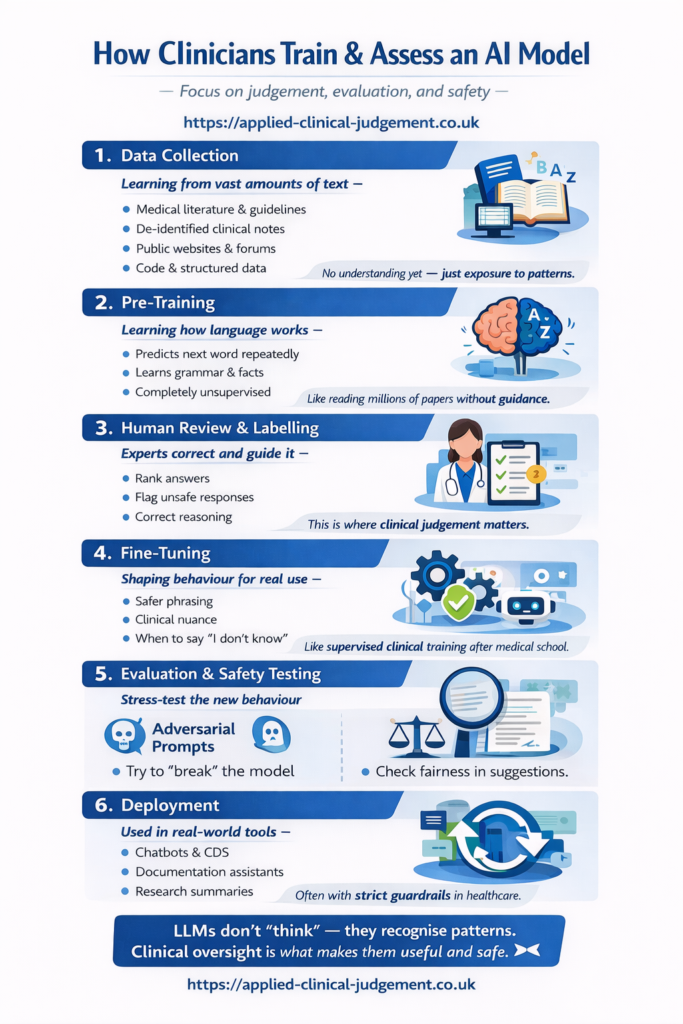
What a good reference answer looks like
When asked to define a “gold standard” response, clinicians are not expected to write the perfect textbook answer. They are expected to reflect how a competent, cautious clinician actually thinks.
That means balancing risks and benefits, acknowledging what isn’t known, safety-netting appropriately, and being explicit about when something should be escalated or referred rather than answered directly. Overconfident or overly comprehensive answers are not what these systems need — and in fact often score poorly.
Why clinicians specifically
Health AI systems learn from patterns. Without clinicians involved in training, those patterns can reward plausibility over safety — producing responses that sound right but apply poorly to real clinical scenarios.
The contextual judgement clinicians bring — knowing when a situation is more complex than it appears, when a caveat matters, when a “correct” answer is still inappropriate — is precisely what data alone cannot provide.
What this work does not involve
- No coding or software development
- No direct patient care
- No identifiable patient data
- No automation of your clinical judgement
This is evaluative, reflective work carried out remotely, typically task by task, on a flexible basis.
How it fits alongside clinical work
Most clinicians doing this work treat it as portfolio or supplementary income alongside NHS, private, or locum roles. Time commitment varies by platform and project, but the structure is task-based rather than shift-based — you are not committing to set hours.
Where to go next
- Am I suited to clinical AI training work?
- What kinds of contract work are available?
- How does the onboarding process work?
Next steps